
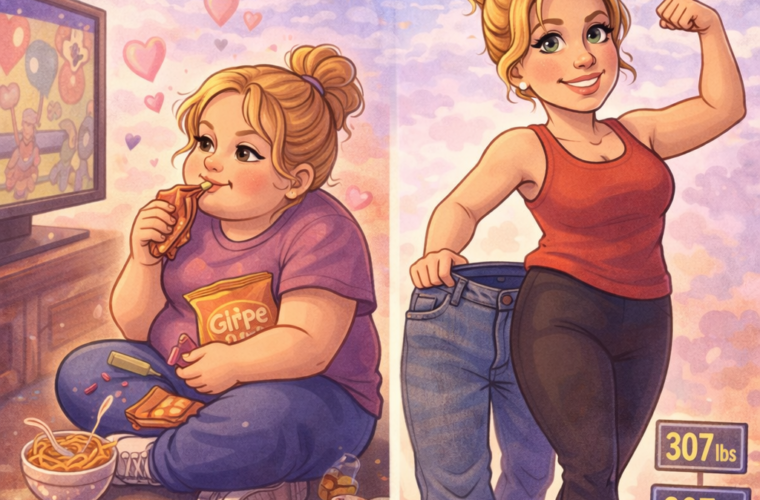
I didn’t wake up one day and decide to lose 100 pounds.
I grew into it.
My mom always told me I started gaining weight when I started school. She tried to keep me healthy — but she also wanted peace. So when I traded my carrots for raw Mr. Noodles and ate them like a snack, she didn’t fight it.
That was the pattern.
Food was accessible.
Food was soothing.
Food kept everyone calm.
By grade five, I was a size 12.
By grade six, I remember barely fitting into a trampoline park harness while an employee put on special gloves to lift me.
By ten years old, my grandmother was commenting on my weight.
I played sports. I was active. But my cardio was terrible, and no one ever pushed me to get better.
Looking back now — as a behaviour analyst — I understand something I didn’t then:
I learned by exposure.
I learned that after school meant two hours alone with candy and TV.
I learned that after dinner meant more snacks and more TV.
I learned that food regulated emotions.
And I was a kid with ADHD.
I was social but awkward.
My report cards read: “Hard to focus. Likes to talk.”
I wanted people to like me so badly. I just didn’t know how to make that happen.
And somewhere along the way, I decided people didn’t like me because I was fat.
So I turned to the one thing that always felt consistent.
Food.
The Yo-Yo Years
I don’t even remember when I crossed 200lbs — probably high school.
In 2015, I moved out and hired a personal trainer. I lost about 40lbs in a few months. But when I moved back home and old patterns resurfaced, the weight came back — and then some.
By 2016, I was 255lbs.
That’s when I found CrossFit.
I didn’t lose a ton of weight at first. But I felt strong. I ran a 10k. I did a half marathon. I competed. I completed an all-nighter charity workout.
By the end of 2017, I was 240lbs.
Then life happened.
Career stress.
A severe concussion from a car accident.
A job I didn’t enjoy.
Grief watching one of my best friends lose her father.
Government funding shifts that threatened my career.
By June 2019, I was 295lbs.
And then 2021 hit.
COVID. Isolation. Stress.
I reached 307lbs — the highest I’ve ever been.
I even considered weight loss surgery. I tried Ozempic. I was violently ill daily. My body rejected it.
And I finally realized something important:
There is no quick fix that replaces behaviour change.
The Turning Point (That Wasn’t Dramatic)
There wasn’t one big “aha” moment.
There were many small ones.
I moved back home. I lost some weight.
I dated someone. The weight crept back up.
I moved downtown. I joined F45 because it was across the street — removing friction matters more than motivation.
That’s an ADHD lesson.
If it requires too much activation energy, it won’t happen.
I made fitness low effort.
I showed up even when I was grumpy.
(I owe F45 an apology for those first few visits.)
I started building community instead of just chasing a number.
And then I hired a nutrition coach.
That changed everything.
The Formula That Actually Worked
By November 2025, I was 210lbs.
By February, I was 202lbs.
Nearly 100 pounds down from my highest weight.
Here’s the truth:
I didn’t do anything extreme.
- I found movement I genuinely enjoy.
- I reduced friction so showing up was easy.
- I built community so I wasn’t alone.
- I hired a coach when I hit my limit.
- I followed a simple, repeatable formula.
Was I perfect? Absolutely not.
Do I still self-sabotage sometimes? Yes.
But I don’t spiral anymore.
Because habits compound.
And when you build a new identity slowly — one workout, one meal, one choice at a time — the old behaviours start losing power.
The ADHD Truth About Weight Loss
For those of us with ADHD:
We chase dopamine.
We struggle with delayed gratification.
We default to comfort when overwhelmed.
Weight loss isn’t about discipline.
It’s about:
- Environment design.
- Reducing friction.
- Community accountability.
- Simple systems.
- Repetition.
I didn’t lose 100lbs because I suddenly became a different person.
I lost it because I built systems that supported the person I already was.
And Yes — The Demons Still Show Up
The difference now?
I have awareness.
I have support.
I have structure.
And I know that habits are stronger than motivation.
You can change anywhere.
But you have to set yourself up to win.
If you’re reading this thinking:
“I’ve tried everything.”
I promise you haven’t tried everything — you just haven’t tried the right structure yet.
And structure beats willpower every single time.