Let’s talk about nutrition and ADHD.
Actually—let’s zoom out a bit.
Let’s talk about nutrition and human behaviour.
Because the more I work on my own habits, the more I realize this isn’t just about food. It’s about patterns. It’s about dopamine. It’s about how we cope, regulate, and function day to day.
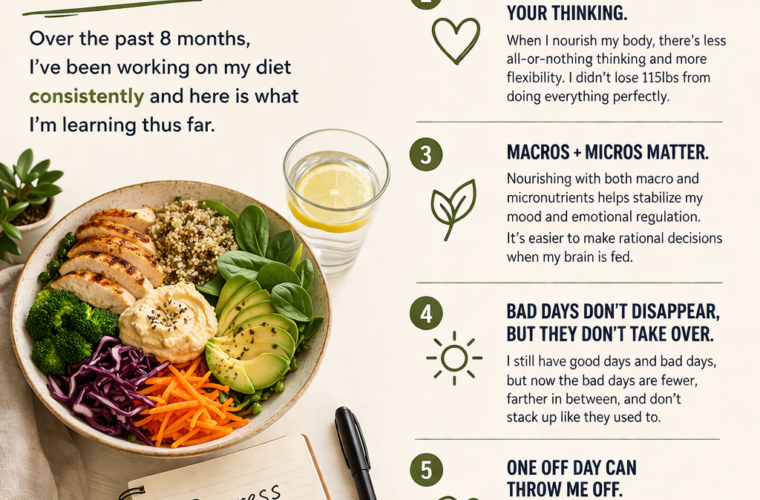
Over the past 8 months, I’ve been consistently working on my diet. Not perfectly. Not obsessively. But consistently enough to start noticing patterns.
Here’s what I’m learning so far.
1. Addiction isn’t just “lack of willpower” — it’s wiring
Addiction is a beast.
And I don’t say that lightly.
Whether it’s sugar, alcohol, or weed—when I have even a small amount, it’s like my brain lights up. The dopamine spike hits, and suddenly my brain is like:
“More. We want more of that.”
It’s not logical.
It’s not controlled.
It’s automatic.
And this is where ADHD plays a huge role—because our brains are already wired to seek stimulation and reward. So when something delivers a quick hit of dopamine? It’s game over… unless you’re aware of it.
But here’s the part that actually gave me hope:
The more you abstain, the easier it gets.
Your baseline resets.
Your cravings quiet down.
Your brain stops screaming for the next hit.
And when you do slip? (Because you will—it’s part of being human.)
It’s not a reset to zero.
It’s actually easier to get back on track than it used to be.
That’s growth.
2. Nourishment changes your thoughts more than you think
This one surprised me.
When I consistently nourish my body, my thinking changes.
Not dramatically overnight—but enough to notice.
There’s less:
- All-or-nothing thinking
- Catastrophizing
- “Screw it, I already messed up” spirals
And more:
- Flexibility
- Rational thinking
- Emotional steadiness
And I don’t think that’s a coincidence.
When your brain is under-fueled, it’s harder to regulate emotions. It’s harder to pause before reacting. It’s harder to choose the “better” option.
A nourished brain = a more regulated brain.
And also…
Progress helps rewire thinking too.
I didn’t lose 115 lbs by being perfect.
I did it by showing up imperfectly—over and over again.
That repetition is what weakens the all-or-nothing mindset.
3. Macros matter—but micros are the quiet game-changer
We hear a lot about protein, carbs, and fats.
And yes—they matter.
But what I’ve really started noticing is how much micronutrients impact how I feel.
Vitamins. Minerals. Electrolytes.
These are the things that support:
- Brain function
- Energy levels
- Mood stability
- Emotional regulation
When those are off?
You feel it.
And not always in obvious ways—it shows up as irritability, low motivation, brain fog, or just feeling “off.”
When you’re properly nourished, it becomes so much easier to make rational decisions.
Not because you suddenly have more discipline.
But because your brain actually has the resources to function properly.
4. The bad days don’t disappear—but they stop taking over
I still have bad days.
That hasn’t changed.
But what has changed is the pattern.
Before:
Bad day → bad night → bad next day → spiral
Now:
Bad day → reset → move on
They’re fewer.
They’re farther apart.
And they don’t chain together the same way.
That’s a huge shift.
Because success isn’t about eliminating bad days.
It’s about shortening how long you stay stuck in them.
5. One off day can still throw me off—and that’s okay
Here’s the honest part:
Sometimes, even one day off my routine throws me.
Not always—but enough that I notice it.
And when that happens, there’s friction.
That “stuck” feeling.
That resistance to getting back into it.
That voice saying, “Just stay here. It’s easier.”
This is where most people quit.
Not because they don’t care—but because the friction feels too heavy.
But what I’m learning is this:
Friction doesn’t mean failure.
It means you’re in the transition.
And pushing through that moment—even imperfectly—is what builds resilience.
6. Building the new path is what actually makes it easier
This might be the most important one.
The more energy you put into building the new path, the easier it becomes to follow it.
At the beginning, everything feels hard:
- Planning meals
- Making better choices
- Saying no to old habits
- Staying consistent
But over time?
Those same behaviours become automatic.
Not because you got more motivated.
But because you built a habit.
And habits reduce decision fatigue.
They reduce friction.
They make consistency feel… normal.
You’re not forcing it anymore.
You’re just doing it.
Final Thoughts
This whole journey has made me realize something:
This isn’t about dieting.
It’s about learning how your brain works—and then building systems that actually support it.
Especially with ADHD.
Because if you try to rely on motivation alone?
You will burn out.
But if you focus on:
- Nourishing your body
- Understanding your patterns
- Building habits instead of chasing perfection
Everything starts to shift.
Slowly.
But sustainably.
Call to Action
If you’re reading this and thinking:
“This is exactly what I struggle with…”
You don’t have to figure it out alone.
This is literally what I help my clients with.
Not just workouts.
Not just meal plans.
But the behaviour side of it:
- The all-or-nothing thinking
- The inconsistency
- The “why can’t I just stick to it” frustration
If you want support building something that actually works for your brain, reach out.
Send me a message, or check the link in my bio to learn more about my coaching.
Let’s build something sustainable—together.