The Experience of Starting Again
Today I want to talk about something that feels simple on the surface, but is actually quite complex.
Doing something you love… and not being good at it.
I started playing volleyball back in 2010.
A friend at work asked if I wanted to join a rec league because they needed extra players. At the time, I was morbidly obese. I had always liked sports, but my body didn’t move the way I wanted it to.
I had tried volleyball once before in elementary school, but no one really took the time to teach me. It was quietly assumed that I just wasn’t athletic.
So I carried that belief with me.
But when I started playing in that rec league, something shifted.
I had fun.
And not just surface-level fun—the kind where you feel present, engaged, and part of something. I kept playing for a few years after that. I wasn’t the best on the team, but I wasn’t the worst either. I lived somewhere in the middle.
And for a long time, that felt like enough.
What Changed
Last night, I went to my first volleyball clinic and game in over a decade.
And, to no one’s surprise but my own, my skills did not sustain themselves.
I felt behind.
Out of sync.
Like I was constantly trying to catch up.
What stood out most, though, wasn’t my performance—it was my internal response to it.
The ADHD Layer: Perceived Rejection
For many people with ADHD, there is a concept called rejection sensitive dysphoria (RSD).
It is often described as an intense emotional response to the perception of rejection or failure.
Not necessarily actual rejection.
Perceived.
The people at the clinic were kind. Supportive. Patient.
There was no indication that anyone felt I was holding them back.
And yet, internally, that was the narrative playing on repeat.
I felt like I was slowing the group down.
Like I wasn’t keeping up.
Like I didn’t belong at that level.
The Contradiction of Joy and Defeat
What made this experience more complicated is that I genuinely enjoyed it.
I smiled the entire time.
I laughed. I moved. I played.
And then I went home and felt completely defeated.
That contradiction is hard to sit with.
How can something bring you so much joy and, at the same time, trigger such a deep sense of inadequacy?
The Stories We Carry
Part of it, I think, comes from the stories we carry.
If you have spent years feeling like you are “not good enough,” moments like this don’t exist in isolation. They connect to every other time you have felt behind, excluded, or incapable.
They reinforce an already well-established pathway.
If you’ve read my previous posts, you’ll know I often describe these patterns like rivers.
The more water that flows in the same direction, the deeper the river becomes.
And last night, I could feel that river pulling me in.
The Grief of Starting Over
There is also a layer of grief.
A quiet “what if.”
What if I had kept playing?
What if I had been more consistent?
What if my brain didn’t make it so hard to stick with things?
Maybe I wouldn’t feel like a beginner again.
And if I’m being honest, I don’t like being a beginner.
I don’t like being bad at something I care about.
Shifting the Narrative
But here is where I am trying to shift the narrative.
Not perfectly. Not all at once. But intentionally.
Because the way I would have handled this in the past looks very different.
I would have shut down.
Avoided going back.
Turned the frustration inward.
Instead, I am trying to respond with something else.
What I’m Practicing Instead
I am trying to focus on what is within my control.
Practicing in smaller, more manageable ways.
Breaking skills down into single components.
Repeating movements until they begin to feel familiar.
I am reminding myself that learning does not happen all at once.
It happens through repetition.
Through exposure.
Through showing up, even when it feels uncomfortable.
Redefining Success
I am also trying to shift how I measure success.
Not “am I good at this yet?”
But:
Did I show up?
Did I try?
Did I stay?
Because staying is often the hardest part.
Comparison and Context
Comparison is another piece I am working through.
It is easy to look around and measure yourself against people who have been practicing consistently for years.
But that comparison is incomplete.
It ignores time.
It ignores repetition.
It ignores experience.
Of course they are better.
They practiced.
When Frustration Turns Into Something Else
There is also the practical reality that some activities require other people.
Volleyball is not a solo sport.
And sometimes, finding someone to practice with can feel like rejection—even when it isn’t intended that way.
That feeling can be uncomfortable.
Frustrating.
At times, overwhelming.
And when those emotions build, they often look like anger.
The urge to quit.
To lash out.
To turn that frustration inward.
If you know that feeling, you are not alone.
But acting on it does not move you forward.
It just deepens the same river.
A Different Response
So instead, I am trying to do something different.
I am trying to redirect that energy.
To use the frustration as fuel for practice, rather than proof that I should stop.
Because the reality is this:
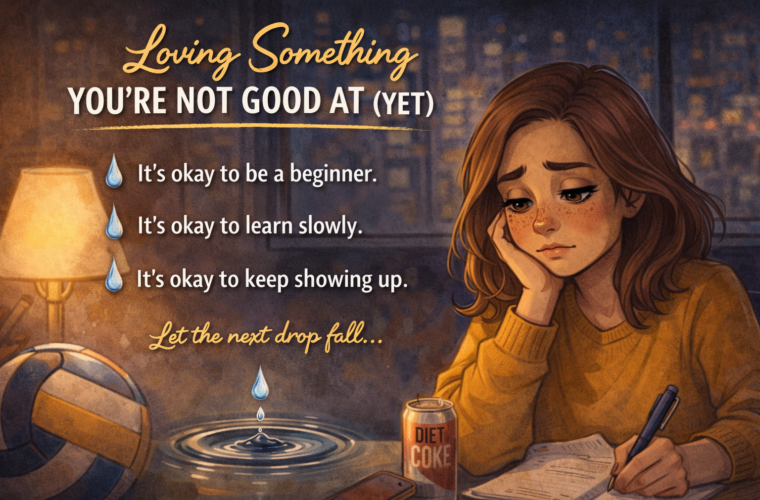
You cannot get good at something without first being bad at it.
And being bad at something you love is a very specific kind of discomfort.
A Gentle Reminder
So if you are in that space right now—where you care about something, but feel like you are not good enough at it—
Maybe the goal is not to feel confident right away.
Maybe the goal is simply to stay long enough for the next drop of water to fall in a different place.
Because one moment does not create change.
But repetition does.
Showing up does.
Trying again does.
If This Feels Familiar
If this resonated with you, I’d invite you to sit with it for a moment.
What is something you love, but struggle to feel “good enough” at?
Or something you’ve been avoiding because you don’t want to be a beginner again?
You don’t have to have the answer right now.
Just noticing it is a start.
And if you are in that uncomfortable space—
Stay.
Give it one more try.
Let the next drop fall. 💛