
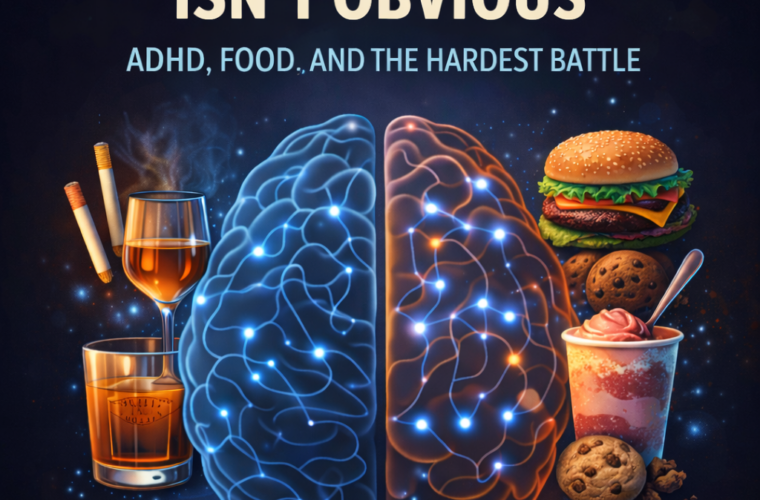
There’s a lot out there about the connection between ADHD and addiction.
And honestly… it makes sense.
We operate based on reward systems. Dopamine drives so much of what we do. And when you have an “addictive personality,” it often doesn’t just disappear—it just… shifts.
You’re not necessarily quitting an addiction.
You’re swapping it.
The “Swap” That No One Talks About
A classic example is smoking.
From a behaviour analysis perspective, one of the most common strategies is to replace the behaviour you want to stop with something else.
So instead of a cigarette, people use:
- gum
- hard candies
- mints
- anything that satisfies that oral fixation
And look—I’m not here to discredit that.
Choosing candy over cigarettes?
That’s a win.
There are risks and benefits to every decision, and that trade-off is often worth it.
But here’s where things get complicated.
When the Addiction Becomes Food
Food addiction is, in my opinion, one of the hardest addictions to navigate.
Because you can’t avoid it.
You have to face your addiction every single day.
You can remove alcohol from your house.
You can avoid certain environments.
But food?
You need it to survive.
Food Is More Than Just Food
Food isn’t just fuel.
It’s emotional. It’s cultural. It’s relational.
- Grandma feeds you because she loves you
- You go through a breakup → ice cream
- You celebrate → food
- You’re stressed → food
And on top of that, sugar has been shown to trigger reward systems in ways that are comparable to other addictive substances.
So now we’re not just dealing with hunger.
We’re dealing with:
- comfort
- connection
- coping
- dopamine
That’s a different beast entirely.
The Danger of Getting It Wrong
So how do we approach food addiction?
First—we do NOT vilify the person.
Because one of the biggest risks when addressing food addiction…
is swinging too far in the other direction.
Into restriction.
Into obsession.
Into eating disorders.
A Moment That Didn’t Sit Right With Me
I remember going through my personal training certification.
There was a practice question that asked something along the lines of:
“How would you motivate someone who doesn’t seem to be putting effort into the gym?”
One of the answer options was:
“Remind them they are earning their calories for later.”
I was working with a pro trainer at the time, and I remember feeling… disgusted.
I said it out loud:
That mindset is dangerous.
Because what happens when someone already struggles with their relationship with food?
You’re not motivating them.
You’re reinforcing restriction.
You’re tying worth to food.
And the worst part?
That was the correct answer.
Addiction Doesn’t Disappear—It Redirects
It’s pretty well established (especially online) that a lot of “gym rats” are former addicts.
And honestly?
There is NOTHING wrong with that.
Redirecting addictive energy into something like fitness can be incredibly powerful.
The benefits can absolutely outweigh the risks.
But we still need to be aware:
Anything can become an addiction.
My definition?
Pursuing something to the detriment of your health.
- One drink? Probably fine.
- Five drinks every day? Problem.
- Adjusting your calories occasionally? Fine.
- Tying your worth to a number on the scale? Not fine.
- Exercising regularly? Amazing.
- Feeling like you have to “earn” food? Dangerous territory.
The Thoughts We Don’t Say Out Loud
I’m not speaking from a place of theory here.
I’ve had those thoughts.
- “You don’t deserve to eat until you lose a pound.”
- “Run 5 miles first, then you can eat.”
And if you’ve had them too…
You know how loud they can get.
And here’s the part that sucks:
Those thoughts don’t just magically disappear.
For a lot of us, they’re lifelong battles.
The Plot Twist No One Expects
But here’s the thing.
And it’s a BIG thing.
The way out… is not restriction.
It’s the opposite.
It’s fueling your body.
Yeah. I know.
The exact thing your brain is telling you not to do.
But your brain needs nutrients to function.
When you don’t fuel it:
- you fall back into default patterns
- intrusive thoughts get louder
- regulation gets harder
When you do fuel it:
- your brain works better
- your body works better
- your metabolism works better
You are literally giving yourself the capacity to think differently.
So… How Do You Balance It?
How do you navigate the line between:
- food addiction
- and disordered eating
There’s no one-size-fits-all answer.
But here are a few starting points:
- Work with someone who understands both behaviour and nutrition
- Surround yourself with people who get it
- Stop tying your worth to numbers (scale, calories, etc.)
- And most importantly…
Recognize how hard this actually is.
You’re Not Broken—This Is Just Complex
Food addiction isn’t a lack of discipline.
It’s a layered, emotional, neurological experience.
And if you’re struggling with it?
You’re not weak.
You’re not lazy.
You’re dealing with one of the most complex relationships there is.
If You Want Support
This is exactly the kind of work I do.
Not just workouts.
Not just nutrition plans.
But helping you understand:
- your behaviour
- your patterns
- your relationship with food and movement
In a way that actually supports your brain—not fights it.
If this resonated with you, you don’t have to figure it out alone.
Reach out. Let’s work through it together.