Today I want to talk about a concept called ableism.
Most people describe ableism as the assumption that everyone has the same physical or mental ability to execute behaviours and achieve desired outcomes. In other words, society often assumes that if something needs to be done, everyone should be able to do it the same way.
But there is another perspective on ableism that I find particularly thought-provoking.
Professor Gregor Wolbring from the University of Calgary describes ableism through a different lens: the idea that our worth becomes tied to our ability to produce. From this perspective, ableism is closely connected to capitalism. We live in a system that values productivity and consumption, and those who produce the most are often seen as more valuable.
This is a theory that I have always struggled with.
I grew up in a household where conversations about money and productivity were common. I remember hearing phrases like, “Wow, someone gave you five dollars — what are you going to spend it on?” Investment portfolios and financial growth were frequent topics of discussion. Success, whether explicitly stated or not, often seemed tied to what you produced and accumulated.
However, many of those conversations happened beyond my immediate family. While money and investing were discussed around me, I was never really taught how to save or manage money — only how to spend it. This often led to judgment and ridicule from extended family members, which made the topic of money feel more like something to be embarrassed about than something to learn and grow from.
Which makes my current situation difficult.
Right now, I am on a sick leave from work.
My productivity is close to zero. My income is not far from that either. Rationally, I know this break is necessary for healing. But emotionally, I struggle with the feeling of lack of worth that can creep in when you are no longer producing in the way society expects.
I find myself sitting with an uncomfortable thought: I am still consuming — paying rent, buying groceries, living my life — but I am not producing in the same way I used to.
And that thought can feel heavy.
For many people with ADHD, the feeling of “not good enough” is deeply familiar. Research shows that children with ADHD often receive significantly more negative feedback than their neurotypical peers. Over time, those repeated messages shape internal narratives about competence, value, and self-worth.
How could that not affect us?
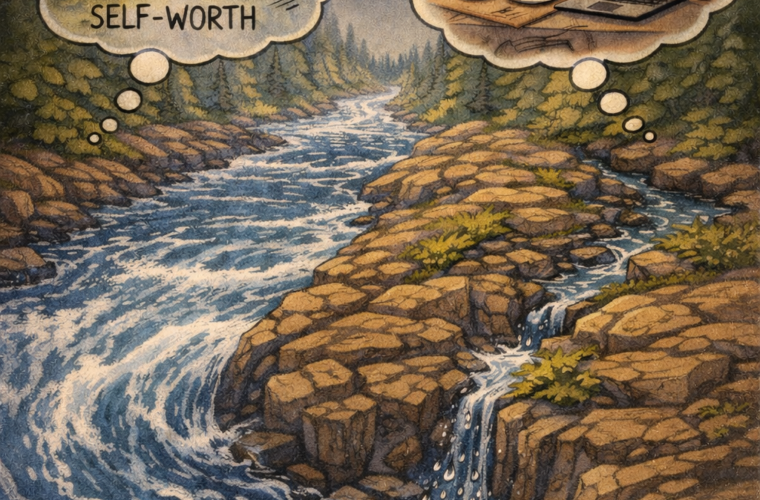
If you’ve read my previous posts, you’ll remember that I often describe behaviour — including our internal dialogue — like rivers forming over time.
The more water flows in the same direction, the deeper the river becomes.
The same is true for thoughts and behaviours. The more a thought is repeated, the stronger that mental pathway becomes. Over time, it begins to feel automatic.
Which means that if we want to change those internal narratives, we need to start dropping water somewhere new.
The droplets, in this case, are the small moments where we remind ourselves:
You are enough.
Think about it this way.
If someone breaks their leg and needs to wear a cast, we don’t shame them for resting. We understand that healing requires time and reduced activity.
So why do we shame ourselves when we need a break for our mental health?
One drop of water does not create a new river.
It takes repetition.
Day after day.
Thought after thought.
Moment after moment.
So as I sit here drinking my coffee and typing on my ridiculously expensive (albeit somewhat old) laptop, I am trying to remind myself of something important:
I am more than my job.
I am more than what I produce.
I am more than my financial worth.
The world may not always see it that way.
But the people who truly matter do.
And maybe, with enough drops of water, I will start to believe it more deeply myself.