
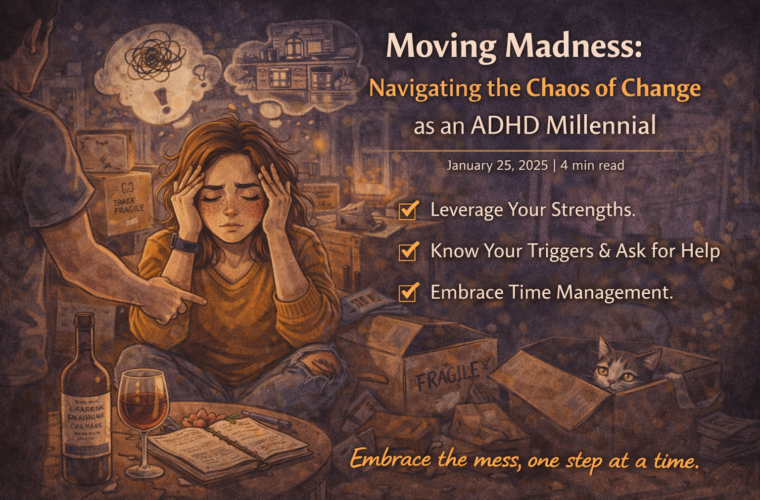
Well, it’s done. I’m mostly moved into the new place, and let me tell you… it’s overwhelming. Moving is ranked as one of the most stressful life events, and I can attest to that. There have been many tears shed amid the chaos, coupled with a profound inability to control my emotions. Thankfully, I had one of my best friends helping me every step of the way. While I am immensely grateful for their support, I’ll be honest—man, were they getting on my nerves!
As someone with ADHD, I often grapple with executive functioning challenges, and encountering monumental tasks (like moving) transforms even the smallest changes into monumental hurdles. The first few days in my new apartment were suffocating with clutter, an eyesore that kept me in a state of dysregulation. And now, I’m faced with the nearly impossible task of figuring out how to fit all the items from my old, sprawling kitchen into a new one that’s barely half the size. It feels like a puzzle I can’t solve, and the pieces just keep spilling out everywhere.
My struggle has been a blend of inherent ADHD traits: my response inhibition gets tested as I try to stop myself from yelling at my friend for, let’s face it, packing “wrong.” Flexible thinking? Absent. I often get so entrenched in “my way or the highway” that I lose sight of the fact that there’s more than one right way to do many things. And the result? Infuriation that bubbles up from deep within. If emotions were liquid, I would’ve evaporated in a cloud of frustration.
So how do I cope with this whirlwind of moving-induced chaos? Here are a few strategies I’ve found to be immensely helpful:
1. Leveraging My Strengths
I might get frustrated easily, but I’ve worked hard to analyze why. What exactly is making me feel this way? Is it the packed boxes? The clutter? The change itself? Recognizing the triggers helps me to pinpoint what calms me down—whether it’s putting on my favorite music, taking a brisk walk, or simply stepping outside for some fresh air. Accepting my patterns allows me to leverage my personal strengths rather than being derailed by my weaknesses.
2. Know Your Triggers and Ask for Help
Knowing what triggers my frustration is crucial. Before I hit that boiling point, I try to communicate my needs clearly, especially with those I trust. I’ve learned to ask for help from individuals who understand me and, crucially, who are comfortable enough to call me out when I’m being too nitpicky. The right support can work wonders. It’s not just about delegating tasks; it’s about having a safety net of people who know my quirks and help keep me grounded.
3. Time Management: A Crucial Tool
Despite it not being a strong suit of mine, good time management has been invaluable during this process. I’ve started to integrate planned breaks into my day to avoid overwhelming myself. It’s a simple tactic, but really committing to stepping away, taking a breath, and giving myself permission to take a moment can refresh my spirits. It allows me to come back to the task at hand with a clearer mind and renewed energy.
So, as I continue to unpack and set up this new space, I hold on to these coping strategies. Moving is tough, especially for someone like me navigating the neural pathways of ADHD chaos, but each challenge is also an opportunity to learn more about myself. If you’re out there navigating a similar struggle, know you’re not alone. Embrace your strengths, acknowledge your triggers, and remember: it’s perfectly okay to ask for help. After all, we’re human. And sometimes, we just need to lean on our friends—if only for a moment.
I hope you continue to join me on this rollercoaster ride of ADHD life in all of its hidden beauty. Here’s to finding peace amidst the clutter and learning to dance with the disarray. After all, it’s not just about where we’re going, but how we choose to get there. Until next time – keep noticing the small victories you have with yourself!
@neurodivergentmillennial